
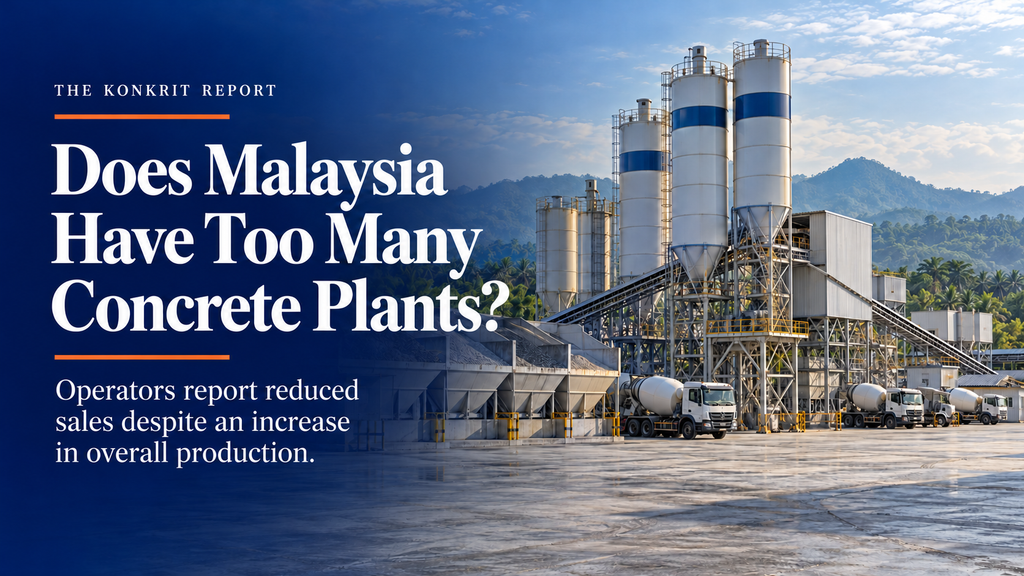
Some Concrete, Ready-Mixed Concrete plant operators report reduced sales, yet national production figures show an increase. Moreover, how can both be true—and what does this tell us about available plant capacity?
Recent Department of Statistics Malaysia (DOSM) figures show that Concrete, Ready-Mixed Concrete production reached 40.94 million m³ in 2024.
However, it declined by 5.0% to 38.88 million m³ in 2025.
During January–August 2026, production recovered to about 27.04 million m³, up 5.8% from the same period in 2025.
At the current rate, the industry may reach 40 million m³, similar to 2024, which supports Concrete, Ready-Mixed Concrete demand.
The figure is encouraging.
However, the growth does not mean that every operator is experiencing higher demand for Concrete, Ready-Mixed Concrete.
Additionally, some are not enjoying the growth.
The question is why?
What the production figures show
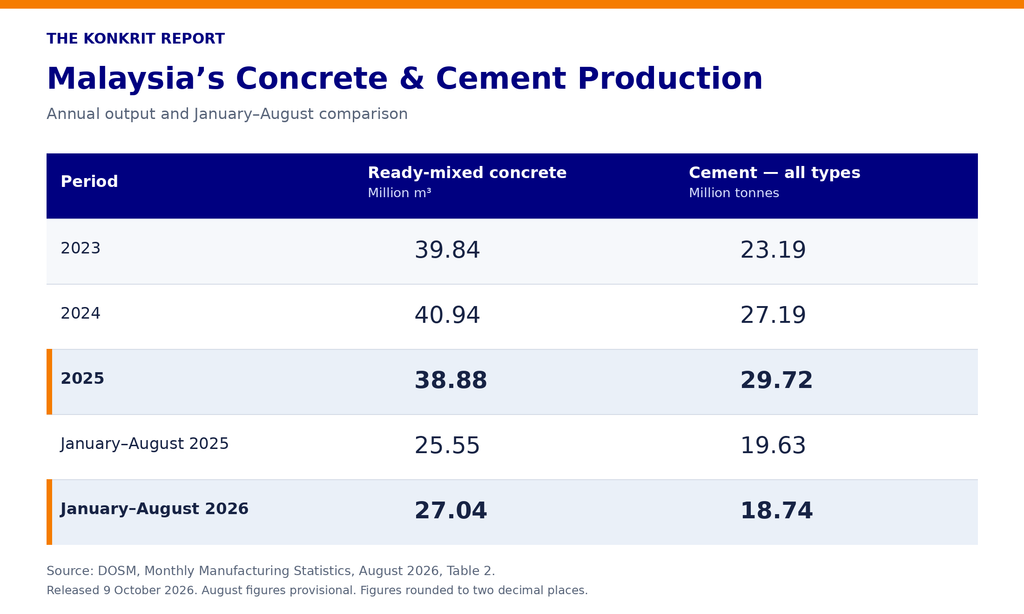
Cement followed a different pattern. Production increased by 9.3% in 2025, then declined by approximately 4.5% during January–August 2026 compared with the same period in 2025. Cement tonnage may be at 28.8 million tonne’s in 2026, lower than 2025. Cement serves several markets beyond ready-mixed concrete, so the two-production series should be assessed separately. For cement we need to take note that many ready mixed players are using alternative material such as GGBS and Fly ash for up to 30%.
In summary we can conclude concrete production has not reduced. Hence the question, why some players are NOT enjoying the growth. To answer this question, we explore the current production capacity in the market.
How much could existing plants produce?
To estimate Concrete, Ready-Mixed Concrete output, we used a base of 1,000 plants per CIDB PPS registration. Additionally, we assessed two assumed plant production rates: 45 m³/hour and 60 m³/hour.
Each scenario assumes seven operating hours a day, 26 days a month and 12 months a year. Production efficiencies of 80% and 90% are then applied.
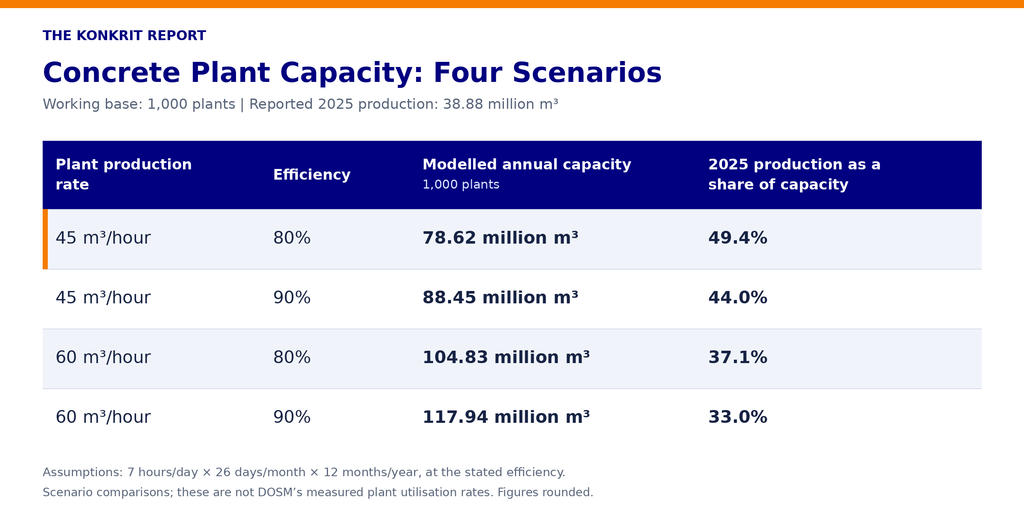
Taking a conservative figure of 45m3/ton, the RMC capacity is double (78.62 million m3) compared to 2025 production.
Therefore, we can conclude that we have substantial spare production capacity under the stated assumptions.
If we take an absolute number, in term of plant numbers a total of 600 plants are sufficient to supply the forecasted figure of 40.8 million m3 in 2026. This probably explain why some players are not enjoying the growth.
Concrete capacity is a local issue
Before we get alarmed on this overcapacity issue, we need to acknowledge that, the national total combines activity across many local markets. Some major markets such South Johor has seen tremendous demand for concrete, while many other operators are experiencing fewer orders.
Ready-mixed concrete must be supplied within practical delivery distances and times. Spare capacity in one location cannot automatically meet demand elsewhere.
A nominal 30 km service radius is a useful starting point, but traffic, road access, site conditions, simultaneous pours and customer requirements determine what a plant can reliably serve.
For operators in high demand area, will face challenges such entry of new competitors in the market and pricing may likely to drop until the new competitor has sufficient production volume, before they bring the price up. This situation is happening in South Johor market; hence existing players has reported drop in production volume.
The good news is this trend has been happening for many years. A case in point is Ipoh market. A market, that we call as green market with fewer competitors and good margin has, over the years become a red market with many competitors entered the market and no substantial increase on concrete requirements.
What is interesting to note is that, despite overcapacity, we find players from large and medium category continue set-up new plants. And this will put pressure on all players secure volume by letting go margins.
Where Is the Industry Heading?
Production may recover, but will the way concrete plants operate improve with it?
From our observations, overcapacity in the industry had led to little changes in plant operations. Equipment may have been replaced and batching systems upgraded, yet daily practices often remain dependent on individual experience, manual follow-up and fixing problems as they arise.
Overcapacity patterns are likely to continue; hence meaningful operational change may remain limited in the coming years.
Where operators face uncertain orders and pressure on margins, investment in better equipment and staff development may continue to receive a low priority. Maintenance can become focused on keeping the plant running today, while improvements that could strengthen tomorrow’s performance are postponed.
In some concrete plants, time appears to stand still. The plant gets older, experienced people leave, newer people, most likely foreign workers are hired with minimum training and development.
No wonder, concrete operations does not get much respect from clients and for many it is about who can offer better pricing.
The industry as a whole need to come together to address this situation.
An industry can produce more concrete while making little progress in how its plants are operated.
For QSE Konkrit, the priority is to help operators strengthen the performance of the assets and people they already have: reliable equipment, consistent concrete quality, competent and capable personnel, and disciplined operating processes.
Data reference: DOSM August 2026 detailed tables, released 9 October 2026. Capacity calculations are illustrative scenarios based on the assumptions stated in this article.
